SEO tells you if Google finds you.citara tells you if AI cites you.
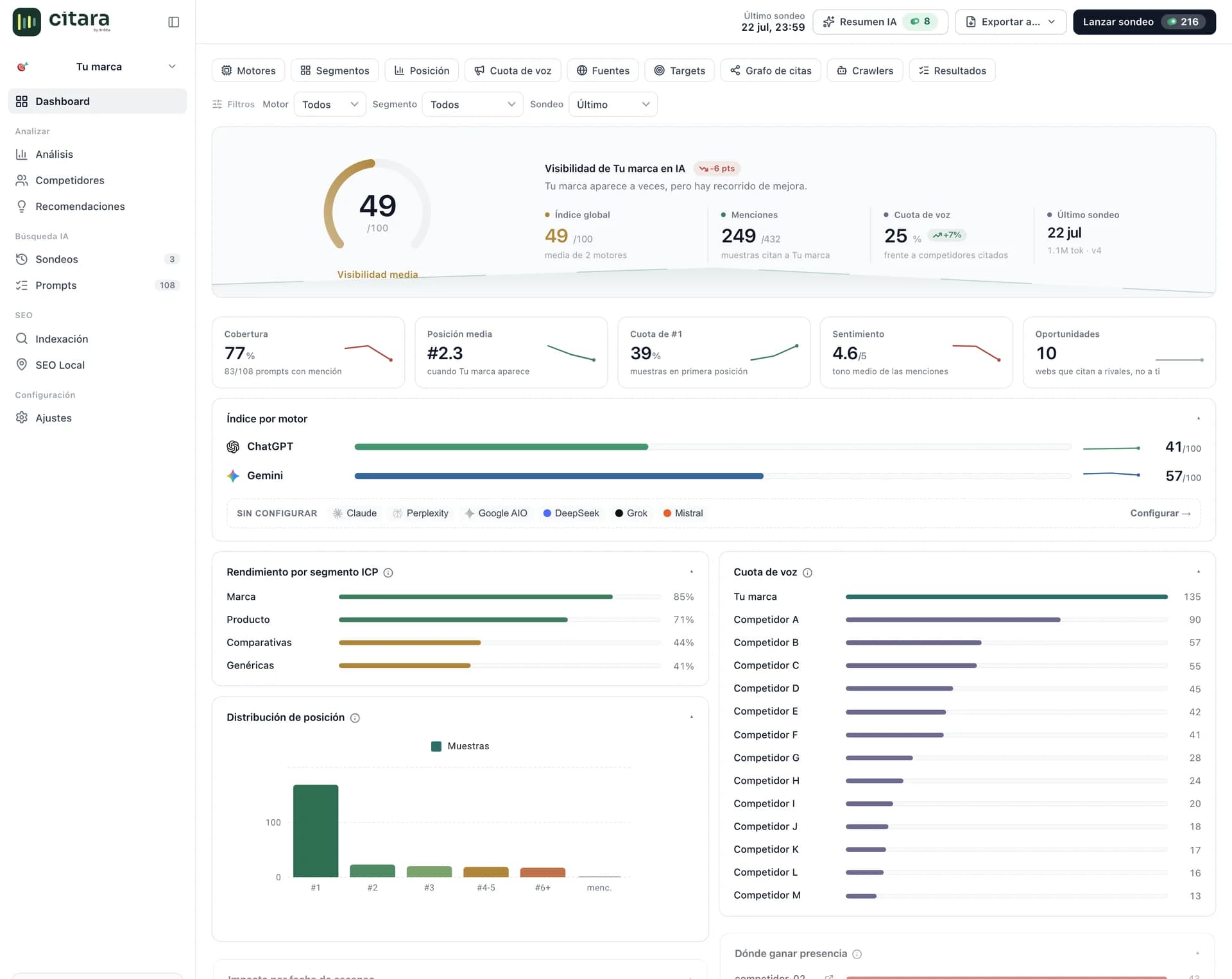
A real capture of a client dashboard with no figure retouched. The monitored brand, its competitors and the domains are anonymised.
Your analytics can't see half of search
Same question, three runs
Your brand shows up in two of three. With a single query, the conclusion depends on which one you got.
Asking once proves nothing
Models are stochastic: the same question yields different answers. Opening ChatGPT and asking whether it knows you is an anecdote, not data. citara repeats every query and works with the mention rate.
Where the answer comes from
The sources holding your category up. Your own site weighs what it weighs: almost nothing.
You don't know what it trusts
Every answer leans on specific sources. If you're absent from the ones holding up your category, no amount of your own content will get you into the answer.
What Search Console measures
One engine out of five. The other four answer your buyers without passing through it.
Search Console doesn't reach
GSC measures classic Google search. Generative answers never pass through it, and neither do the other seven engines.
For product teams
What your buyer sees when they ask about your category
No SEO knowledge needed to read this. Someone with a budget opens ChatGPT and asks. They get three names and a couple of sources. If you are not among those three names, you are not on the shortlist — and no click fixes it, because there was never a results page to fight over.
What citara measures
Whether you are named, in which position, against whom, and which pages the AI trusts to decide it. Repeated several times per question, because the models do not answer the same way twice.
Why it matters now
The decision happens inside the answer, not in a list of ten links. Ranking seventh in a list was an opportunity; missing from a three-name answer is not existing.
What you can do with it
Answers come from specific pages: a thread, a comparison site, a review. Those are addresses you can go to. The product hands you the ranked list, not generic advice.
I need a construction firm to refit a warehouse near Reading. Which ones would you recommend?
It appears in none of the four examples. Not because the AI ruled you out, but because none of the pages it leans on mentions you. That is exactly what citara measures and prioritises.
Simulated examples used to explain the product: they are not screenshots, the names are generic and the source domains are invented. The real answers for your category, with real names and sources, come in the report.
Four steps, on a loop
Your question set
Each query is repeated across the five engines with web search on. The signal is the mention rate, not a one-off answer.
Several samples per engine
Each query is repeated across the five engines with web search on. The signal is the mention rate and the average position, not a one-off result.
Analysis
Mentions, position, normalised competitors — "Hiberus", "Hiberus Tecnología" and "Hiberus S.L." count as one — and the sources each answer leans on.
Deltas and alerts
Every run is compared with the previous one. Only what changed reaches Telegram: entering or dropping out of the top 3, losing the mention, a new competitor. Not the raw score.
Five engines, one index
A 0-100 index per engine and aggregated, weighted by position: first place is 100 and each position below subtracts 18, with a floor of 20; a mention without a ranking counts 60; absence, 0. Comparable across engines and across runs.
All with web search · they return the sources they cite
Eleven views, one question: do you appear?
The readouts in this section are illustrative samples: they show the shape of each view, they are not any client's data.
Sources
The domains AI cites — and the filter that actually matters: only the ones you're still absent from.
Targets
A prioritised, actionable list. Only what shows up in two consecutive runs makes it in, so you're not chasing noise.
AI crawlers
How often AI bots read your site, split into training, search indexing and live visits.
Visibility index
0-100 per engine and aggregated, weighted by the position you're named in.
Share of voice
How much of your category's answers is yours, and how much your competitors take.
Position
Where you land when you do appear. Being the seventh name on a list is not being there.
Segments
Slice by question type or funnel stage: informational, comparative, purchase-intent.
Citation graph
Which sources hold up your category, how much each one weighs, and how they connect.
Google indexation
Real per-URL status via URL Inspection, plus clicks and impressions. Deltas every night.
Reputation
How AI describes you, not just whether it names you: attributes, tone and what it associates you with.
PDF report
The deliverable you send the client or take to the board, generated straight from run data.
When ChatGPT comes to read your site, someone just asked about you
AI bots are not all the same. citara splits them into three families, and the third is the one that counts: it means a real user asked a question and the engine went to read your page to answer it. It's the closest thing there is to a click from an AI answer.
It installs as a middleware on your site. The ping is fire-and-forget, with no added latency, and the bot list lives on the server: when a new bot shows up you don't have to redeploy anything.
Honestly: user agents can be spoofed, so treat this as a strong signal rather than absolute truth. And watch your robots.txt — block a bot and it won't crawl you, so you won't appear in that engine.
Training
GPTBot · ClaudeBot · CCBot · Bytespider
They feed training corpora. Long-term effect, hard to attribute.
Search index
OAI-SearchBot · PerplexityBot · Claude-SearchBot
They index for AI search products. If they don't come through, you can't show up there.
Live visits
the one that countsChatGPT-User · Claude-User · Perplexity-User
Someone asked and the engine came to read you to build the answer. Cross this with the visibility index and you have the full picture.
Already running on real brands
ISDIN
Dermocosmetics
A set of purchase and comparison queries on sun protection, monitored across the five engines, tracking the sources the AI cites when recommending.
andorra.com
Reference portal · Andorra
Its own set of local and service queries, watching which domains hold up answers about the country and where presence is missing.
The reports themselves are under NDA, so we don't publish them: we'll walk you through them on the demo, with the data on screen.
Built by dribba, the studio behind these apps
citara is not a weekend experiment: it comes out of the studio that has been shipping product for these brands for years. This row is dribba's client list; the accounts actually running citara are named above, with their sector.
Not a walled garden: the data comes out
Everything in the dashboard sits behind an authenticated REST API, and alerts land where you already work. If you want the data in your own BI tomorrow, you don't depend on us.
REST API
Every endpoint, with your own key. Runs, sources, targets, crawlers and indexation.
Telegram alerts
Only the changes that matter, not every run's raw score.
Middleware for your site
One file in your Next.js repo and you start counting AI bot visits.
Google Search Console
URL Inspection and Search Analytics inside the dashboard, analysed nightly.
Cron and n8n
Runs fire from Cloud Scheduler or from your own workflows.
CSV and PDF report
To take to the board or cross-reference in your own spreadsheet.
You pay for what you consume
Each run spends credits based on questions × engines × samples, and the tokens of every call are recorded, so you see the real cost per run instead of a surprise invoice from four providers. The allowance renews each calendar month, and there are packs if you run short.
starter
One brand, a short question set, monthly runs. To start measuring and get a baseline.
3.000
credits/mo
from 29 €/mo
growth
One brand with the full question set and frequent runs. The normal use for a marketing team.
12.000
credits/mo
agency
Several brands, each in its own isolated workspace with its own set and history. Built for agencies and groups.
40.000
credits/mo
Questions we get
No. Asking once is an anecdote: models are stochastic and answer the same question differently. citara repeats each query several times across the five engines and works with the mention rate and the average position, which are comparable from one run to the next.
It uses the API with the web-search model enabled. That's a very faithful proxy for the app, but it is not the consumer app, and the exact ranking can differ slightly from what you see. We say so plainly: any tool promising otherwise is selling you smoke.
No, and be wary of anyone who promises that. citara tells you where you appear, where you don't, and which sources hold up your category's answers. Earning presence in those sources is content and relationship work — the work we do at Dribba if you'd rather outsource it.
GSC measures classic Google search: it sees neither generative answers nor the other engines. citara integrates GSC inside it (indexation status and per-URL performance), but its actual job is precisely the layer GSC doesn't cover.
The first run gives you a snapshot. The good signal is the deltas, so from the second run onwards. Targets aren't shown until they appear in two consecutive runs, specifically so you don't end up chasing noise.
Yes. Each brand lives in its own workspace, with its own question set, history and alerts, isolated from the others. The agency plan is built exactly for that.
They're inside the credits, not billed separately. Every run records the tokens spent on querying and on analysis, so the cost is visible and attributable.
We'll show you your own snapshot in 30 minutes
We bring your real questions, run a probe and look at it together: where you appear, who is eating your answer, and which sources AI trusts in your category.